
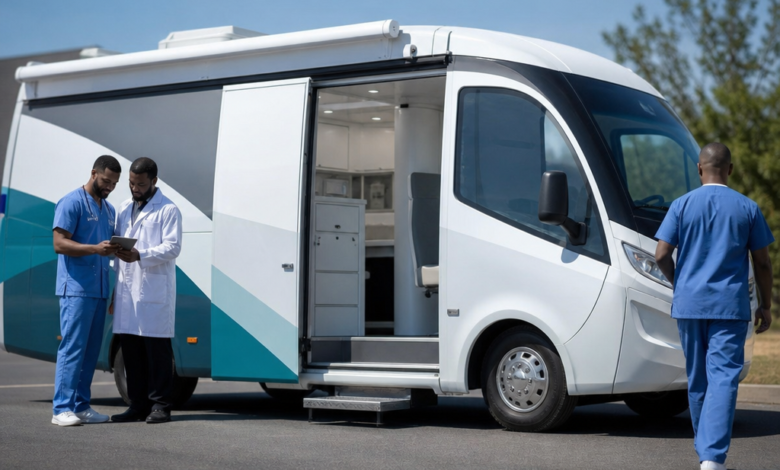
Organizations looking to expand their market reach face a recurring challenge: how do you bring services directly to underserved populations while simultaneously building brand recognition? Mobile branded vehicles offer a practical answer. From healthcare providers serving rural communities to construction companies maintaining visibility across job sites, vehicles function as both service delivery platforms and moving advertisements. The strategic value lies not just in mobility, but in the professional image a well-executed vehicle wrap or graphics package conveys to potential clients and partners.
The Business Case for Mobile Branding
Traditional advertising requires repeated investment—billboards demand monthly fees, digital ads charge per impression, and storefront signage reaches only foot traffic. A branded fleet, by contrast, generates impressions throughout its operational lifespan. Every delivery, service call, or outreach visit becomes a marketing opportunity. For businesses operating across multiple territories or serving dispersed customer bases, this creates compounding visibility that static advertising cannot match.
The economics become particularly compelling for service-based businesses. A delivery company with ten vans makes dozens of stops daily, exposing the brand to hundreds of potential customers without additional media spend. Construction firms moving equipment between sites create consistent presence in high-value commercial corridors. Medical outreach programs traveling to underserved areas demonstrate commitment to community health while building institutional credibility. The vehicle becomes infrastructure that pays dividends across both operations and marketing budgets.
See also: AI-Powered Image Restoration: Bringing Old Photos to Life
Healthcare Outreach and Mobile Medical Units
Mobile medical vehicles have become essential tools for healthcare organizations targeting populations with limited access to traditional facilities. Rural areas, underserved urban neighborhoods, and communities with transportation barriers all benefit from on-site care delivery. Veterans Affairs mobile health centers exemplify this model, bringing diagnostic equipment, pharmacy services, and specialist consultations directly to veterans in remote locations. These units function as fully equipped satellite clinics, complete with examination rooms, lab capabilities, and telemedicine infrastructure.
The branding on these vehicles serves dual purposes. First, it establishes immediate recognition and trust—patients can identify the healthcare provider before stepping inside. Second, it creates longitudinal presence in communities that may receive visits monthly or quarterly. A consistently branded mobile unit signals institutional stability and commitment, which directly affects patient willingness to engage with services. For healthcare networks expanding into new markets or nonprofits building community partnerships, this visible commitment translates into higher utilization rates and stronger community relationships.
Fleet Graphics as Growth Infrastructure
Businesses scaling operations face a common problem: maintaining brand consistency across expanding territories and growing vehicle counts. A poorly executed or inconsistent fleet creates confusion about organizational professionalism and size. Companies that appear fragmented or under-resourced struggle to compete for large contracts, even when their operational capabilities are strong. Fleet branding becomes a visible indicator of organizational maturity and readiness to serve major accounts.
Organizations looking to project cohesive branding across diverse vehicle types—from service vans to heavy equipment—benefit from working with specialists in custom fleet wrap branding who can adapt designs to different vehicle profiles while maintaining visual consistency. This becomes particularly important for businesses running mixed fleets where sedans, cargo vans, box trucks, and specialized equipment all need unified branding. The design system must account for varying surface areas, door placements, window configurations, and operational wear patterns while keeping the brand instantly recognizable from any angle.
The return on investment extends beyond immediate brand exposure. Contractors bidding on commercial projects often find that professional fleet presentation influences selection decisions. Property managers, facility directors, and corporate clients interpret vehicle appearance as a proxy for overall service quality. A wrapped fleet signals investment in the business and attention to detail that carries over into work quality. This perception advantage often tips competitive bids in favor of the better-branded company, even when pricing and qualifications are comparable.
Integration with Strategic Expansion Plans
Mobile branding assets align naturally with deliberate market expansion strategies. When businesses pursue strategic growth engines, they typically combine geographic expansion, service diversification, and brand development. A branded vehicle fleet supports all three simultaneously. Geographic expansion requires local presence—vehicles provide that before brick-and-mortar locations become viable. Service diversification benefits from clear messaging about new capabilities, which vehicle graphics can communicate to existing customers during routine service interactions. Brand development demands sustained visibility in target markets, which mobile assets deliver more cost-effectively than most paid media.
The timing of fleet branding investments matters strategically. Companies entering new markets gain more value from immediate vehicle branding than from delayed campaigns, since first impressions in unfamiliar territories carry disproportionate weight. Businesses repositioning or rebranding benefit from fleet updates that signal organizational evolution to existing customers. Firms consolidating after mergers or acquisitions use unified fleet branding to communicate integration and stability to clients concerned about service continuity.
Operational Considerations and Longevity
Vehicle graphics and wraps typically last five to seven years under normal use, though actual lifespan depends on climate exposure, vehicle washing practices, and storage conditions. Fleet managers should account for wrap depreciation when calculating total cost of ownership for vehicles. Regular cleaning with appropriate products extends wrap life, while harsh chemicals or automated brush washes accelerate degradation. Parking vehicles in covered areas when possible reduces UV damage, the primary cause of fading and material breakdown.
Maintenance considerations also affect design choices. High-contact areas like door handles and fuel access points experience more wear, suggesting either reinforced materials or design elements that minimize graphics in those zones. Companies operating in harsh conditions—construction sites, rural roads, heavy snow or salt exposure—may opt for partial wraps focusing on high-visibility areas rather than full-body coverage. This concentrates budget on surfaces that deliver maximum impression value while reducing replacement costs for frequently damaged sections.
Measuring Impact and Adjusting Strategy
Tracking the effectiveness of mobile branding requires more nuance than digital campaigns with built-in analytics. Businesses can measure impact through customer acquisition surveys that ask how prospects heard about the company, noting increases in “saw your vehicle” responses after fleet branding launches. Call tracking with dedicated phone numbers printed on vehicles provides direct attribution. Companies with geographic expansion plans can correlate new customer density maps with vehicle routing data to identify whether brand awareness grows along service routes.
Market testing before full fleet deployment reduces risk. Organizations with large fleets might brand a subset of vehicles first, measuring whether those units generate more inbound inquiries or whether sales teams report stronger recognition in territories those vehicles serve. This phased approach allows design refinement based on real-world feedback before committing to fleet-wide production. It also spreads capital expenditure across budget cycles, making large-scale branding programs more financially manageable for growing businesses.
Long-Term Strategic Value
Mobile branding assets compound in value as fleets grow and routes expand. A single branded vehicle provides limited coverage, but a fleet of twenty creates saturation across operational territories. This density effect means each additional branded vehicle contributes more than proportional value to overall brand recognition. Customers who see multiple branded vehicles over time internalize the brand as established and reliable, even if they have never directly engaged with the company.
For businesses viewing expansion as multi-year strategy rather than single initiative, fleet branding becomes foundational infrastructure. It creates persistent market presence that supports other marketing efforts, from digital campaigns to partnership development. The branded fleet validates the organization’s scale and seriousness to partners, investors, and major clients evaluating long-term relationships. In industries where trust and stability determine contract awards, that visible proof of organizational investment carries weight that transcends any individual marketing tactic.


